AI Search · SEO Fundamentals
AI Overviews, ChatGPT, Perplexity, and Gemini are changing how people search. But the businesses getting cited in AI answers aren't using secret tricks. They're doing the basics of SEO exceptionally well.
By Alex Odoño · · 6 min read
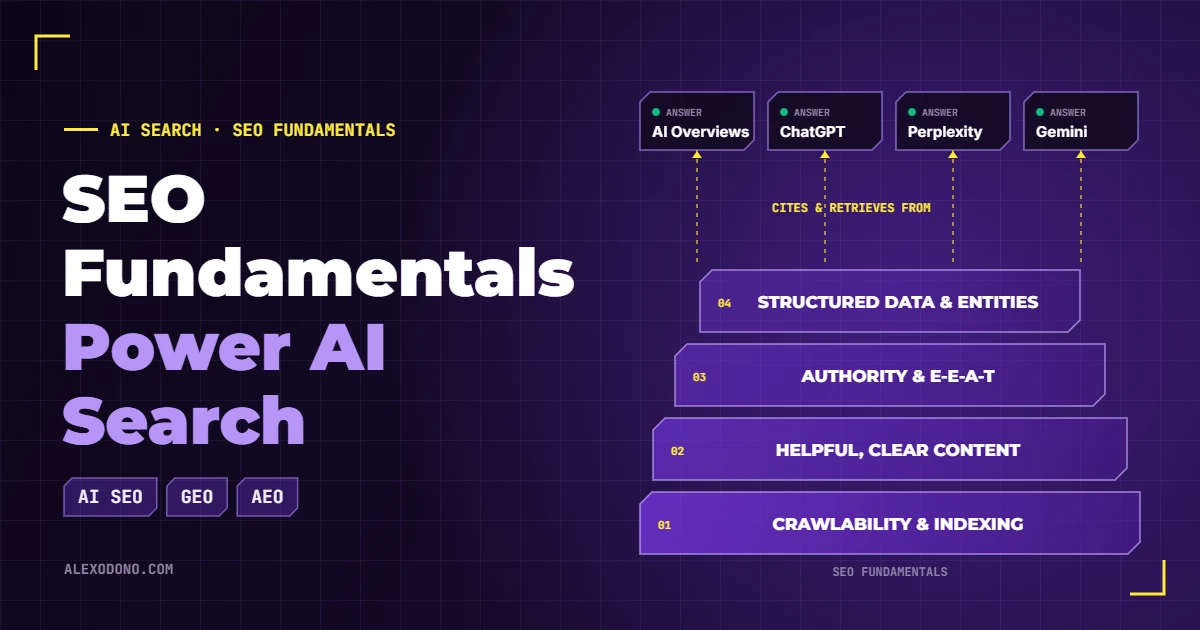
Every few months, a new acronym promises to replace SEO. First it was AI SEO, then GEO (Generative Engine Optimization), then AEO (Answer Engine Optimization) and LLM optimization. Business owners ask me the same question: “Do I need to start over for AI search?”
The short answer is no. AI search tools still need to find, understand, and trust your content before they can quote it, and that is exactly what fundamental SEO has always been about. In this guide, I'll explain how AI search actually picks its sources, which fundamentals matter most, and what is genuinely new.
Key Takeaways
These terms describe the same goal from slightly different angles: getting your business mentioned, cited, or recommended when people ask AI tools for answers.
| Term | What it means | Where it shows up |
|---|---|---|
| AI SEO | Optimizing your site so AI-powered search features use and cite it | Google AI Overviews, AI Mode |
| GEO | Generative Engine Optimization: earning visibility in AI-generated answers | ChatGPT, Perplexity, Gemini, Copilot |
| AEO | Answer Engine Optimization: structuring content to directly answer questions | Featured snippets, voice and AI answers |
The labels are new. The work underneath them mostly isn't.
Large language models don't browse the whole internet every time someone asks a question. When an AI search tool needs fresh, reliable information, it retrieves pages from a search index, picks the most relevant and trustworthy sources, and then writes an answer based on them, often with links back to those sources.
Google is very direct about this. Its AI features use a technique called query fan-out, running several related searches to build a response, and the pages it pulls from come from Google's regular index.
“There are no additional requirements to appear in AI Overviews or AI Mode, nor other special optimizations necessary.”
Google Search Central, AI features and your website
To be eligible, a page simply needs to be indexed and eligible to appear in Google Search with a snippet. ChatGPT works in a similar way: OpenAI uses a crawler called OAI-SearchBot for its search features and recommends allowing it in your robots.txt if you want your site to appear in ChatGPT search answers (OpenAI's crawler documentation).
In other words, if search engines can't crawl, index, and trust your site, AI search tools usually can't either.
If a page isn't indexed, it can't be cited. Broken internal links, accidental noindex tags, slow servers, and blocked resources stop both search engines and AI crawlers. Check your robots.txt to make sure you aren't blocking the search crawlers you want, and use Google Search Console to confirm your important pages are indexed. This is the core of technical SEO.
AI answers are built from passages that directly answer a question. Pages with a clear heading structure, short focused sections, and the answer stated early are far easier to quote than long, vague blocks of text. Write for people first: answer the question, explain it, then add the detail. Good on-page SEO does exactly this.
AI tools favor sources that cover a topic thoroughly. A single article rarely builds that trust. A cluster of related pages, linked together in a logical way, shows search engines and AI systems that you are a reliable source on the subject.
When an AI tool recommends a business or quotes advice, it leans on sources that look credible. Real author bios, first-hand experience, reviews, and mentions on respected websites all matter. Earning those mentions is what link building and digital PR is for, and it's especially important in high-trust niches like law firm SEO.
Schema markup won't get you into AI answers on its own, and Google notes that no special markup is required. But accurate structured data that matches your visible content helps search engines understand who you are, what you offer, and where you operate, which reduces the chance of being misunderstood or misquoted.
Ask an AI tool for “the best dentist near me” or “a family lawyer in Makati” and it often draws on business listings, reviews, and local pages. A complete Google Business Profile, consistent business details across the web, and strong location pages remain the foundation of local SEO, and of local AI visibility.
Some things have changed. AI answers mean fewer clicks for simple questions, so being cited and mentioned matters alongside ranking. It's worth tracking visits from AI tools in Google Analytics, checking how AI assistants describe your business, and writing content that answers questions clearly and completely.
What hasn't changed is the foundation. Google states you don't need new machine-readable files or special AI text files to appear in its AI features. Be careful with anyone selling a “GEO hack” that skips the basics. Shortcuts that didn't work for search usually don't work for AI either.
No. GEO builds on SEO. AI search tools rely on the same crawling, indexing, and quality signals as traditional search, so strong SEO is the foundation for AI visibility.
Not for Google. Google says you don't need new machine-readable files or AI text files to appear in AI Overviews or AI Mode. Focus on crawlable, helpful content first.
Check referral traffic from AI tools in Google Analytics, search for your brand and services in tools like ChatGPT and Perplexity, and watch Search Console data, since AI Overviews and AI Mode traffic is included in your Search Console reports.
AI search is changing how people discover businesses, but it hasn't changed what makes a website worth recommending. Sites that are technically sound, clearly written, well-linked, and trusted are the ones AI tools keep citing. Get the fundamentals right, and you're building visibility for traditional search and AI search at the same time.

Alex Odoño is an SEO specialist based in Imus, Cavite, with 6+ years of hands-on experience in law firm SEO, local SEO, and technical SEO for businesses in the US and the Philippines.
Get a free SEO audit. I'll check whether your site is crawlable, indexed, and structured the way search engines and AI tools need, and show you what to fix first.